Josh and Jolene Logo
Login | Register (360) 223-4501
  • Home
  • Contact
    • Contact
    • Testimonials
  • Search Homes
    • Main Home Search
    • Bellingham
    • Birch Bay
    • Blaine
    • Ferndale
    • Lynden
    • Whatcom County
    • Skagit County
    • Edgemoor Homes
    • Lake Whatcom
  • Commercial
    • Main Search
    • Location
      • Bellingham
      • Blaine
      • Ferndale
      • Lynden
      • Whatcom County
      • Skagit County
    • Property Type
      • Multi-Family
      • Industrial Buildings
      • Retail Buildings
      • Hotels and Motels
      • Commercial Land
      • Office Buildings
      • Mobile Home Parks
  • Resources
    • All Posts
    • Moving To Bellingham
    • Bellingham Neighborhood Guide
    • Buyers
    • Jolene
    • Josh
  • Probate and Estate
  • Multi-Family

Growing Demand for Cold Storage Facilities | Definition, Types, and Investment Outlook

November 9, 2025 by Jolene

Cold storage facilities are one of the fastest-growing sectors in commercial real estate, driven by expanding food distribution, pharmaceutical logistics, and supply chain modernization. Fueled by changing consumer habits, supply chain optimization, and advanced logistics technology, temperature-controlled warehouses have become essential to modern commerce.

Before discussing growth, it is important to understand what cold storage actually is.

What Is Cold Storage?

Cold storage refers to temperature-controlled warehouse facilities designed to store perishable goods such as food, pharmaceuticals, seafood, and agricultural products. These facilities maintain specific temperature ranges to prevent spoilage, protect product integrity, and ensure compliance with safety standards.

Cold storage plays a critical role in the modern cold chain, the uninterrupted system that moves temperature-sensitive goods from production to the end consumer.

As commercial real estate brokers tracking industrial and logistics development in Washington State, we monitor cold storage demand closely because it directly impacts regional investment strategy.

In Bellingham, cold storage demand is closely tied to seafood processing, cross-border trade, and proximity to regional port infrastructure.

Cold Storage Temperature Ranges

Different products require different controlled environments:

Chillers and Coolers: 32°F to 55°F or 0°C to 13°C for produce, dairy, and flowers
Freezers: 0°F or lower, typically -18°C, for frozen foods, meat, and seafood
Ultra-Low or Deep Freeze: As low as -85°C or -122°F for vaccines and specialized pharmaceuticals

These facilities require heavy insulation, industrial refrigeration systems, advanced air circulation, and backup power infrastructure.

Types of Cold Storage Facilities

Public Cold Storage: Third-party logistics providers offering space to multiple companies
Private Cold Storage: Owner-operated facilities used by manufacturers or distributors
Blast Freezers: Rapid-cooling systems for newly processed goods
Micro-Fulfillment Cold Storage: Smaller facilities positioned closer to end consumers

With this foundation in place, the investment story becomes clearer.

Why Cold Storage Is Surging

As e-commerce, grocery delivery, and food distribution networks expand, businesses are prioritizing access to high-quality cold storage. National grocery chains, seafood processors, pharmaceutical distributors, and meal-kit providers are competing for limited space, driving up lease rates and development interest.

Today’s cold storage facilities are highly specialized logistics assets built for precision, energy efficiency, and automation. For tenants, these buildings are mission-critical. For investors, they represent long-term, income-producing assets with strong retention.

For Washington State investors, especially across Bellingham, Whatcom, and Skagit Counties, regional distribution and proximity to ports add strategic value.

Modern Cold Storage Design

Most existing cold storage facilities were built before 2000. New construction is being designed with:

Advanced insulation systems
Energy-efficient refrigeration
Real-time temperature monitoring
Automated inventory systems

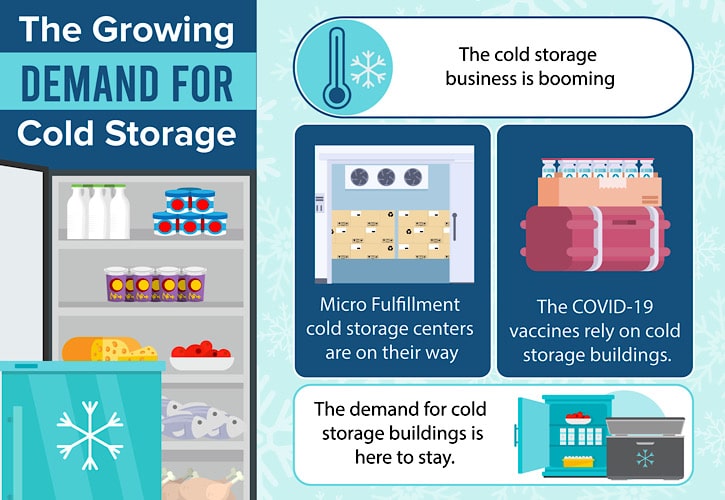
A growing trend is micro-fulfillment cold storage. These smaller distribution hubs are positioned closer to consumers. In the Pacific Northwest, this reduces transportation costs and shortens delivery times for seafood, agriculture, and specialty food products.

Who Is Driving Cold Storage Demand in Washington?

Cold storage demand extends well beyond grocery chains.

Pharmaceutical companies require controlled storage for vaccines and medications.
Seafood exporters depend on freezing and processing capacity.
Agricultural producers require refrigerated distribution before shipment.
Meal-kit and direct-to-consumer food companies rely on rapid regional distribution.

With access to ports, agriculture, and cross-border trade, Bellingham and Skagit County remain strategic locations for cold storage development.

Cold Storage Investment Outlook

Cold storage real estate continues to outperform traditional industrial sectors due to:

Lower vacancy rates
Higher build-out costs that increase tenant retention
Long-term lease structures
Supply constraints due to high development costs

For developers, the opportunity lies in modern, flexible designs that meet energy standards and tenant-specific operational requirements.

For investors, cold storage represents stability backed by national logistics demand and regional production strength.

Cold Storage FAQ

What is a cold storage facility?

Cold storage refers to temperature-controlled warehouse facilities used to store perishable goods such as food, seafood, pharmaceuticals, and agricultural products. These properties are part of the cold chain and require specialized refrigeration, insulation, and monitoring systems.

What temperature is considered cold storage?

Cold storage typically ranges from 32°F to 55°F for refrigerated goods, 0°F or lower for frozen products, and as low as -85°C for ultra-low pharmaceutical storage.

Why is cold storage in high demand?

Demand is driven by e-commerce grocery delivery, pharmaceutical distribution, seafood export activity, and population growth. Limited supply and high construction costs also contribute to strong lease rates and low vacancy.

Is cold storage a good investment?

Cold storage properties often offer long-term leases, strong tenant retention, and lower vacancy compared to traditional industrial assets. In markets like Washington State, proximity to ports and agriculture strengthens long-term demand.

Final Thoughts

Cold storage facilities are no longer a behind-the-scenes industrial niche. They are one of the fastest-growing and most resilient asset classes in commercial real estate.

Understanding what cold storage is and how it functions is the first step. Recognizing its strategic importance in Washington State is the next.

Cold Storage Real Estate in Washington State

We are Josh and Jolene Baijot, commercial real estate brokers in Bellingham WA, specializing in industrial, multifamily, and investment properties.

We work with investors evaluating cold storage acquisition, conversion, and development opportunities throughout Bellingham, Whatcom County, and Skagit County.

If you are considering adding cold storage or industrial assets to your portfolio, contact us through this website to discuss current market conditions and available opportunities.

Read More Commercial Insights

Explore more commercial real estate strategies and market trends:

  • What Is Your Whatcom or Skagit Commercial Property Worth?
    Learn how to determine your property’s current value and position it strategically in today’s market.

  • Five Tips for Buying a Warehouse
    Discover how to identify, finance, and optimize warehouse investments for long-term growth.

  • Three Tips for Buying Commercial Real Estate
    A quick guide to evaluating commercial properties and building your investment portfolio with confidence.

updated Feb. 2026

Filed Under: Buying Commercial Real Estate, Industrial Buildings / Warehouse, Uncategorized Tagged With: Bellingham Warehouse for sale, Lynden industrial buildings, Washington State warehouse for sale, Whatcom County Warehouse For Sale

About Jolene

Josh and Jolene Baijot have spent more than two decades working in Whatcom County real estate. Their experience spans residential homes, waterfront properties, multifamily investments, and commercial real estate throughout Bellingham and the surrounding communities. Known for their deep local knowledge and strategic approach, they help buyers, sellers, and investors navigate the market with clarity and confidence.

Den Finder

Josh and Jolene Baijot


(360) 223-4501
Contact Us
Listing Alerts Your Property's Value

Categories

  • Apartment Buildings / Multi-Family
  • Best Neighborhoods
  • Buying Commercial Real Estate
  • Cost Of Living
  • Home Buying
  • Home Selling
  • Hotels and Motels
  • Industrial Buildings / Warehouse
  • Life in Bellingham
  • Living In
  • Most Expensive
  • Moving To
  • Office Buildings
  • Real Estate Agents
  • Residential
  • Retail Buildings
  • Selling Commercial Real Estate
  • Things To Do
  • Uncategorized
  • Moving To Bellingham
  • Bellingham Neighborhood Guide
  • Moving To Washington
  • Luxury Homes
  • Waterfront Homes
  • Sell Your Home
  • Bellingham Commercial
  • Blaine Commercial
  • Ferndale Commercial
  • Lynden Commercial
  • Whatcom County Commercial
  • Skagit County Commercial

Josh & Jolene Baijot

(360) 223-4501
4260 Cordata Pkwy Suite 106
Bellingham, WA 98226
Contact Us
  • Email
  • Facebook
  • Instagram
  • Phone
  • YouTube

Listings with the three tree icon are courtesy of NWMLS  •  DMCA Notice   •   sitemap   •   admin   •   ©2026 All Rights Reserved  •  Real Estate Website Design by IDXCentral.com