Industrial real estate has become one of the strongest commercial property classes in recent years. Driven by e-commerce, logistics, and supply chain demand, this sector has historically offered investors steady income, strong returns, and resilience during economic shifts.
While industrial real estate includes everything from manufacturing plants to distribution centers, one of the most attractive niches for investors is multi-tenant industrial properties. These facilities lease to multiple businesses under one roof, providing diversification, flexibility, and multiple streams of rental income.
Below, we’ll cover the types of industrial properties, the advantages and risks, and the 2025 outlook, before diving into why multi-tenant properties are a unique investment opportunity.
Types of Industrial Properties
Industrial real estate covers several property types, each serving a different purpose:
- Manufacturing buildings – These range from heavy industrial facilities for large-scale production to lighter assembly plants that can be reconfigured for different tenants.
- Warehousing and distribution centers – Designed for storage and shipping, these include general warehouses, cold storage for temperature-sensitive goods, and logistics hubs with truck terminals.
- Flex space – Combining office and industrial functions, flex properties can house showrooms, research and development labs, or data centers.
- Multi-tenant industrial properties – Facilities leased to multiple small or mid-sized businesses, offering investors diversified rental income and lower vacancy risk.
Why multi-tenant matters: While a single-tenant facility can sit empty if that tenant leaves, a multi-tenant building continues generating income even with one vacancy.
Advantages of Industrial Real Estate Investing
Industrial properties, and multi-tenant assets in particular, offer several compelling advantages:
1. Steady Income
Industrial tenants often sign long-term leases spanning 5–10 years. For investors, this creates predictable, reliable cash flow. Multi-tenant assets strengthen this by spreading income across multiple businesses.
2. Resilience and Stability
During economic downturns, industrial properties have historically outperformed retail and office because demand for essential goods, logistics, and storage stays steady. Even when consumer spending slows, products still need to move through warehouses and distribution centers.
3. Long-Term Appreciation
Strategic locations near highways, ports, and urban centers typically appreciate in value over time, especially as demand for e-commerce and last-mile delivery grows.
4. Lower Costs
Many industrial leases are structured as triple-net (NNN), meaning tenants pay for taxes, maintenance, and insurance. This lowers operating expenses for property owners.
5. Lower Turnover
It’s costly for an industrial tenant to relocate—equipment, logistics, and fit-out investments tie them to a property. As a result, tenants often stay longer compared to office or retail.
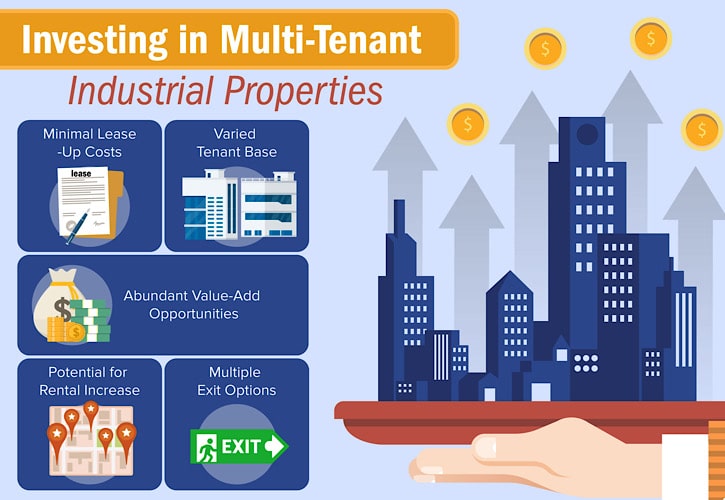
6. Multiple Exit Options
Investors can sell the entire property to another investor, or in some cases convert units into separate industrial condos for higher per-unit returns. This flexibility makes industrial one of the more liquid commercial assets.
Advantages of Multi-Tenant Industrial Specifically
Multi-tenant industrial assets carry all of the above benefits but add unique investor advantages:
- Abundant value-add opportunities – Many properties are under-managed; upgrading facilities and improving tenant mix can raise net operating income.
- Minimal lease-up costs – New tenants typically only require cleaning, flooring, or minor improvements rather than major buildouts.
- Varied tenant base – Spreading leases across multiple businesses reduces reliance on a single company or industry.
Example: Instead of one e-commerce giant leasing a 100,000 SF warehouse, a multi-tenant property might host 15–20 local distributors, manufacturers, and service providers.
Risks and Considerations
Like all investments, industrial real estate carries risks:
- High Capital Investment – Industrial deals often require significant upfront capital compared to residential or small retail.
- Specialized Knowledge – Investors must understand zoning, environmental assessments, and complex lease structures.
- Economic Sensitivity – Though resilient, the sector still reacts to interest rates, trade policies, and global supply chain disruptions.
- Vacancy Risk – A single-tenant facility can sit empty, but even multi-tenant properties risk partial vacancy during downturns.
- Evolving Tenant Needs – The rise of robotics, automation, and high-tech storage facilities means older properties may need upgrades to stay competitive.
2025 Market Outlook and Trends
Looking ahead, several trends are shaping industrial real estate in 2025:
- Moderating Growth – After record highs in 2021–2023, rent growth is cooling, though demand remains steady.
- Supply Chain Diversification – Companies are reshoring manufacturing and warehousing, driving demand for domestic facilities.
- Flight to Quality – Newer, more automated, and energy-efficient facilities are in highest demand.
- Last-Mile Delivery – E-commerce continues to push demand for smaller distribution centers close to population hubs.
Why Multi-Tenant Industrial Properties Stand Out
Among the types of industrial assets, multi-tenant industrial offers a balance of stability and flexibility. With multiple tenants sharing the space:
- Income is diversified across industries (manufacturing, logistics, services).
- Vacancies hurt less because other tenants keep cash flow steady.
- Properties often fly under the radar of institutional investors, keeping entry prices below $20M.
Conclusion
Industrial real estate remains one of the most resilient commercial property classes in 2025. Multi-tenant properties, in particular, offer investors diversified income streams, lower vacancy risk, and strong long-term appreciation potential.
Whether you’re seeking passive income through stable tenants or value-add opportunities through improvements and repositioning, multi-tenant industrial can be a smart way to diversify your portfolio.
Interested in industrial opportunities in [Your Market]? Contact us today to discuss available properties.

Hi! We’re Josh and Jolene Baijot, the creators of this website. We’re also commercial real estate brokers in Bellingham, Washington. Thank you for taking the time to read this blog post. We appreciate your time spent on this site. Please contact us through this website.