
Buying a warehouse in Bellingham starts with knowing how you will use the building, then matching that use to the right location, size, zoning and features. A clear plan and a good tour checklist help you compare buildings with confidence and choose a warehouse that supports your business for years. Here are our best tips for buying a warehouse in Bellingham and Whatcom County, plus the questions we ask on every tour.

In This Guide
- Why Buyers Choose to Own a Warehouse
- Tip 1: Know How You Will Use the Warehouse
- Tip 2: Choose a Location That Moves Your Products
- Tip 3: Match the Size and Layout to Your Operation
- Tip 4: Confirm Zoning and Regulations Early
- Tip 5: Look at Age, Condition and Room to Adapt
- How Much Does It Cost to Buy a Warehouse?
- Is Buying a Warehouse a Good Investment?
- Questions to Ask When Touring a Warehouse
- Buying a Warehouse FAQ
Why Buyers Choose to Own a Warehouse
Online shopping and fast delivery have made warehouse space one of the most useful property types in commercial real estate. Businesses need room to store, pack and ship products, and that steady need keeps well located warehouses in demand. Here in Whatcom County, industrial strength is concentrated along the Interstate 5 corridor in Ferndale and near the Blaine and Sumas border crossings, as we cover on our Bellingham and Whatcom County commercial market page.
Owning a warehouse gives you control. You can set up the space for your operation, add racking, upgrade lighting or power and plan improvements on your own schedule. Each payment builds equity in real property, and ownership can bring tax benefits that are worth reviewing with your CPA. For investors, a warehouse with strong tenants can produce steady income, and industrial tenants often value staying in one place because moving equipment and inventory takes real effort.
Tip 1: Know How You Will Use the Warehouse
The best warehouse for you depends on what happens inside it. A distribution business needs loading doors, truck access and open floor space. A food or produce business may need temperature control, refrigeration or freezer space. A light manufacturer needs the right power, ventilation and floor strength for its equipment. A tech or assembly operation may value newer construction and clean office space more than truck docks.
Write down your must haves before you start touring. Include square footage, ceiling height, the number and type of doors, power, office space, yard and parking needs and any special storage. This list keeps every showing focused and makes it easy to compare buildings side by side.
Tip 2: Choose a Location That Moves Your Products
Location is still the first rule of real estate, and it matters even more for warehouses. Look for quick access to Interstate 5, the Guide Meridian and the truck routes your drivers use every day. Shorter trips save time and fuel on every delivery.
Popular industrial areas in Whatcom County include Ferndale along I-5, north Bellingham near Bakerview Road and Bellingham International Airport and the Lynden, Sumas and Blaine areas close to the Canadian border. Cross border access is a real advantage for companies that ship to or from British Columbia. For one example, see our industrial building for sale near the Canadian border in Lynden.
Think about your team too. A location close to where your employees live makes hiring easier and keeps commutes short.
Tip 3: Match the Size and Layout to Your Operation
Buy for the space you need today plus room to grow. The right size keeps your team efficient and puts your capital to work where it counts. Look at the full layout: clear height for stacking, column spacing for racking and forklifts, office and restroom space and room outside for trucks, trailers and parking.
Ask what equipment comes with the building. Racking, cranes, compressors or cold storage units included in a sale can save you money and time when you move in. Also confirm the floor and doors can handle the forklifts and machinery you plan to bring.
Tip 4: Confirm Zoning and Regulations Early
Every warehouse needs to be zoned for your use. Bellingham, Ferndale, Lynden, Blaine and Whatcom County each have their own zoning codes, and light industrial, heavy industrial and commercial zones allow different activities. Check with the city or county planning department before you make an offer, especially for manufacturing, food processing or any work with hazardous materials.
Health, safety, fire and environmental rules also apply. A building that already meets the standards for your use saves time and money. We help buyers ask these questions early so the feasibility period goes smoothly.
Tip 5: Look at Age, Condition and Room to Adapt
The age of a warehouse tells you a lot about future repairs and upgrades. Newer buildings often have higher ceilings, better insulation and modern electrical systems. Older buildings can offer a great location at a good value, and with the right improvements they can serve a business well for many years.
Look for a building that can grow with you. Ample power, room for more loading doors, a roof that can support solar panels and space to add office or mezzanine areas all add long term value. Plan for a professional inspection of the roof, HVAC, electrical, plumbing and fire sprinkler systems.
How Much Does It Cost to Buy a Warehouse?
The cost to buy a warehouse depends on size, age, condition, location, zoning and features like dock doors, power and office space. A newer building near I-5 with several dock doors will be priced differently than an older shop building on a rural parcel. The best way to see current pricing is to browse Bellingham industrial buildings and warehouses for sale and Whatcom County industrial buildings, then compare price per square foot for buildings with similar features.
Plan for the full cost of owning a warehouse too. Budget for your down payment, inspections, closing costs, property taxes, insurance, utilities and ongoing maintenance. Commercial loans usually call for a larger down payment than a home loan, so talk with a commercial lender early and get prequalified before you tour. If you are buying an investment warehouse with tenants in place, review the income, operating expenses and tenant history with your CPA.
Is Buying a Warehouse a Good Investment?
For many buyers, yes. Warehouses serve a wide range of users, from online sellers and distributors to contractors, food producers and manufacturers. That broad demand gives owners more options when it is time to sell or welcome a new tenant. Industrial buildings are also simpler to operate than many other property types, with fewer common areas and finishes to maintain.
Owner users enjoy stable occupancy costs and the freedom to customize their space. Investors look for steady income backed by strong tenants and a location that keeps attracting businesses. In both cases, the right building in the right location builds long term value.
Questions to Ask When Touring a Warehouse
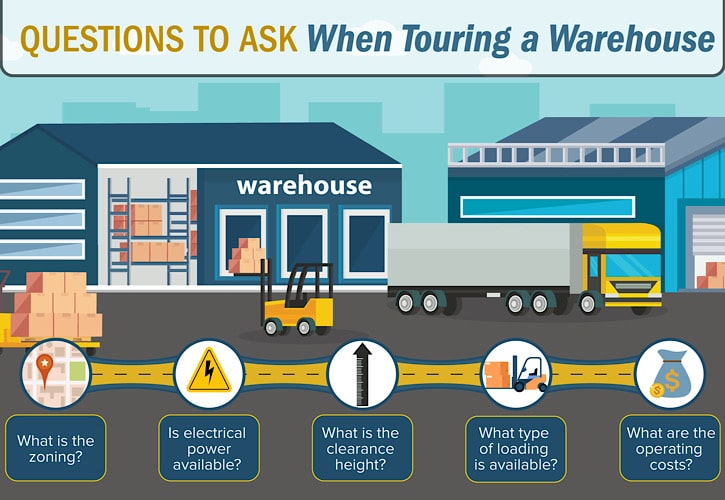
Once you know your needs, bring this checklist to every showing. These questions help you compare buildings quickly and find the one that fits.
- What is the zoning? Confirm the building is zoned for your use so you can open on schedule without a zoning change or extra permits.
- Is there enough electrical power? Manufacturing often calls for 3 phase power. Ask for the amperage and voltage, and have an electrician or electrical engineer review it if your equipment needs a lot of power.
- What is the clear height? Clear height is the usable height under beams, lights and sprinklers. It sets how high you can stack products and racking.
- What type of loading is available? Note whether doors are dock high or grade level, how many there are and their size. Make sure the doors and truck court fit the trucks that serve you, including full size semi trucks.
- What are the operating costs? Ask for recent property taxes, insurance, utilities and maintenance costs so you can build an accurate budget.
- Is there heating, ventilation and air conditioning? Many warehouses heat only part of the space. If HVAC units are in place, have a certified HVAC technician inspect them.
- How are the parking and yard? Look at parking for staff and visitors, space to park trucks overnight, lighting, fencing and security.
- How old are the roof and building systems? Ask for maintenance records and recent upgrades, then follow up with a full inspection.
- Is there room to grow? Ask about extra land, room to add doors or a mezzanine and how the site could expand with your business.
Work With a Local Commercial Team
Buying a warehouse is a big decision, and local knowledge makes it easier. We help buyers find warehouses that fit their use, review zoning and building features and compare pricing across Bellingham, Ferndale, Lynden, Blaine and the rest of Whatcom County. For more on choosing industrial space, read our guide on how to find the right industrial property in Whatcom County, and for the full buying process see How to Buy Commercial Real Estate.
To see warehouses and other buildings for sale today, browse our Bellingham commercial real estate page. Looking outside Bellingham? See Ferndale commercial real estate, Lynden commercial real estate and Blaine commercial real estate.
Buying a Warehouse FAQ
Is buying a warehouse a good investment?
For many buyers it is. Warehouses serve a wide range of businesses, from distributors and online sellers to contractors and manufacturers, so well located buildings stay in demand. Owner users gain control of their space and build equity, and investors look for steady income from strong tenants.
How much does it cost to buy a warehouse in Bellingham?
The price depends on size, age, condition, location, zoning and features like dock doors, power and office space. The best way to see current pricing is to compare similar buildings on our Bellingham industrial buildings and warehouses for sale page, then plan for inspections, closing costs, taxes, insurance and maintenance.
What questions should I ask when touring a warehouse?
Ask about zoning, electrical power, clear height, loading doors, operating costs, heating and ventilation, parking and yard space, the age of the roof and systems and room to grow. Our checklist above covers each one.
Who is the best commercial real estate agent in Bellingham?
Josh and Jolene Baijot are Bellingham commercial real estate brokers with over 25 years of experience with apartment buildings, warehouses, office, retail and commercial land across Bellingham and Whatcom County. Call us at (360) 223-4501.
Talk to us about commercial property in Bellingham
Helping buyers and sellers across Bellingham and Whatcom County
